Episode #18 | August 12, 2025 | All Episodes
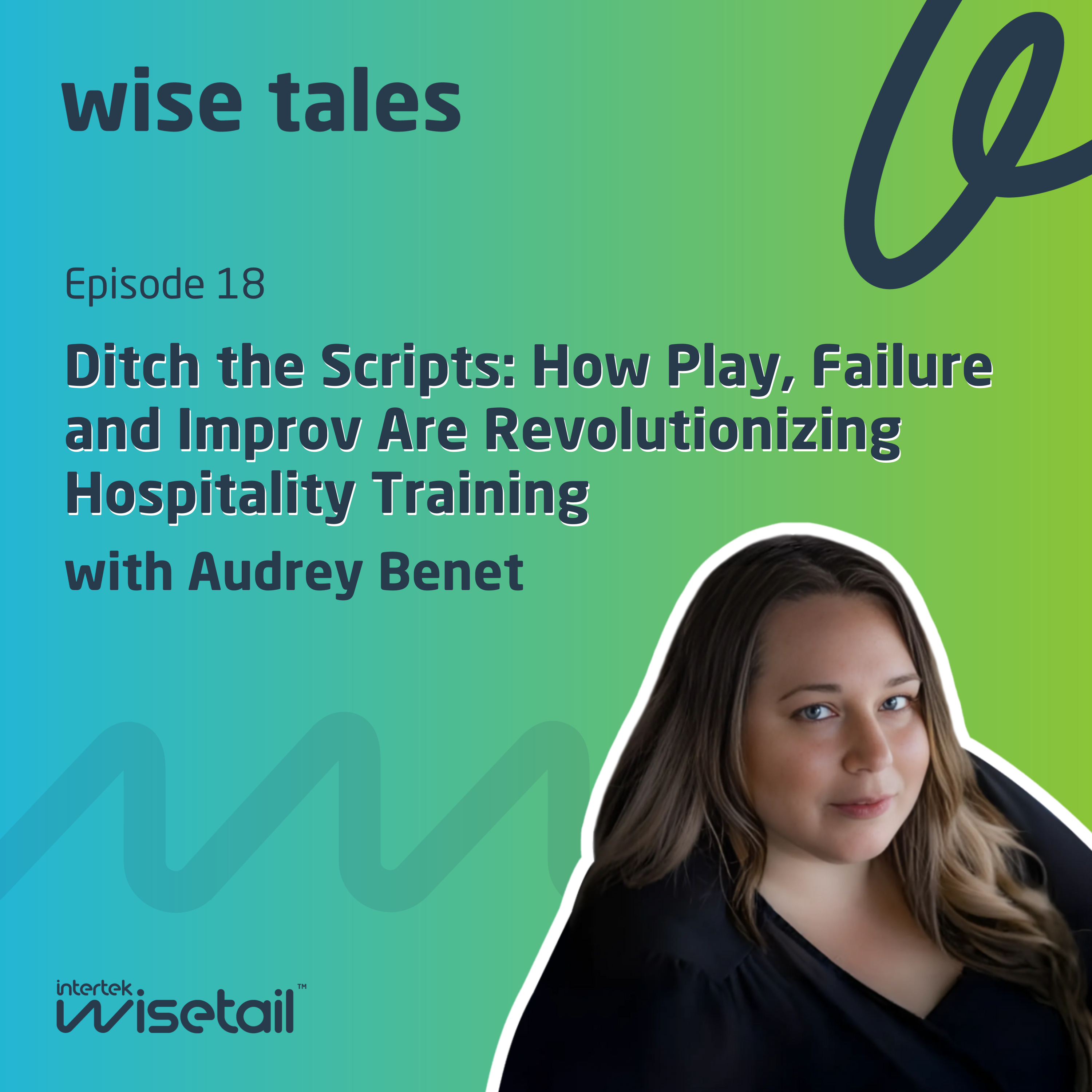
Ditch the Scripts: How Play, Failure and Improv Are Revolutionizing Hospitality Training
Audrey Benet, Director of Training at GuestCounts Hospitality, shares insights into how modern training techniques can transform learning in the hospitality space. With two decades of experience leading operations, culture and training for global brands, Audrey brings a human-centered perspective to scaling systems while prioritizing team well-being.
Audrey outlines how humor, improv and technology help make learning more effective and inclusive. She emphasizes the importance of creating safe environments where team members can fail forward, build soft skills and grow into confident leaders through practical experience and collaborative feedback.



Take a Listen!

Key Takeaways
(02:18) Introducing game-based learning makes training more approachable and removes traditional barriers to participation.
(07:35) Interpersonal dynamics are at the core of service industries, making flexibility and human connection central to effective learning.
(09:39) Technology can support a learner-first approach by allowing individuals to absorb foundational material independently before applying it on the job.
(11:40) Simulated practice and early exposure to decision-making roles can accelerate leadership development and readiness.
(14:20) Communication skills, especially the ability to give and receive feedback, are best developed through frequent, low-stakes repetition.
(16:02) Embedding structured feedback into everyday routines helps build emotional resilience and fosters stronger workplace relationships.
(18:19) Collaborative group training formats can make even sensitive topics, like interview conduct, more memorable and participatory.
(22:03) When organizations create environments that support experimentation and recovery from mistakes, they build deeper trust among teams and strengthen cultural alignment.
Transcript
Audrey: The reality is, the first rule of improv is there are no rules, and you are highly encouraged to fail along the way. When you fail, that's when the funny comes out. Nobody wants, as an audience member, nobody wants to see a perfect scene.
Evan: Audrey Benet is a hospitality trailblazer with over 20 years of experience leading training, operations, and culture for top brands around the world. She's opened dozens of locations from fine dining to quick service and nightlife, and is known for turning teams into powerhouses and chaos into systems.
Her career spans iconic names like Walt Disney World, Chili's, and Tony Romas, where she advanced across roles in training, culinary, and franchise operations. She's led hotel management teams, helped scale franchise systems, and currently serves as the Director of Training for Guest Counts Hospitality, supporting upscale casual dining, nightclubs, ghost kitchens, and newly acquired restaurant brands. Believe it or not, Audrey's journey started at just 16 years old, when she wrote a full-blown training manual for a five-star hotel in Miami. Since then, she's become a proud CHART member, a sought-after speaker, and a frequent collaborator with the National Restaurant Association.
Audrey brings serious operational chops, a deep heart for people, and a great sense of humor to every conversation. Audrey, welcome to Wise Tales.
Audrey: Evan, thank you so much for having me. I'm so excited for our conversation.
Evan: One of the things I want to talk about is humor. Humor is a red thread that is in everything that you do—improv. Let's start talking there because you have replaced traditional role play with improv exercises. I'd love to hear how that evolved, what kind of impact you've seen, anything you want to share about using improv for training.
Audrey: Yeah, so thank you for bringing improv up because this was really just a moment in a CHART conference where the closing keynote speaker was Improv Joel Z., who does a keynote with improv, bringing the crowd in, and I just fell in love with that moment so much that I started taking classes at the SAK Comedy Lab here in Orlando. And as I'm in class, it's like instant notes of, "Ooh, this game could apply in this training class," or, "This game could apply." And so I have really fallen in love with it.
Just yesterday, I was in Atlantic City, training wine, and used an improv game asking them to collaborate with each other to, in essence, teach each other how to do something. You know, it's just a fun, exciting way to do something that, when we do traditional role play in classes, nobody wants to go up on stage. Nobody cares to get up there. They hem and haw. When I'm opening restaurants and we have like a B-role play day, the very first set of "guests" who come up to the host stand—the hosts just look around at a completely empty restaurant and don't know where to send them.
This idea of roleplaying jams them up, puts them into a state of paralysis. But when you put it into the context of a game, they're all in and want to course correct, play the game, be on the stage. It almost creates a parameter of how do you make it fun and how do you really think in different terms. They're more focused on the game itself than being worried about making themselves a fool. It's really fascinating.
Evan: So I think that's really interesting because I'm completely talking out of school here, zero experience doing improv. I've watched a lot of it in my day, but it's sort of this "Yes, and," right? And so it almost seems like it gives people permission to be in the moment where they don't even feel like they're learning. They're just in this immersive experience trying to get to that "Yes, and" with their partner or with the group that they're working with.
Audrey: Yeah, and it's funny because I think we all think of improv as "Yes, and" being the first rule. The reality is, the first rule of improv is there are no rules, and you are highly encouraged to fail along the way. When you fail, that's when the funny comes out. Nobody wants, as an audience member, to see a perfect scene.
And so you start to develop this really beautiful story when somebody says completely the wrong thing. That's for starters. On the learning side, there is a real clear difference between active learning and passive learning, with some really great research centered around metacognition—which is the thinking of how you think—that says active learners, when you are actively engaged in how you will learn and think about how you'll retain the information, those people retain 93% of the information a month after they have tested for it. Passive learning? They only retain about 76% of that information a month afterward.
So when we think about a classroom setting where we're lecturing, we're teaching, we get them to role play—where they're so scared out of their minds they get paralysis in the process—they're no longer actively engaged in that, and so they're going to lose a good percentage of what they're supposed to be learning.
Framing in the game, like the other rules of improv are you're there to play. We don't call people actors. They're not, yes, improvisers. But really instead of saying, "Who wants to go next?" it's "Who wants to play?" And so everything's centered around a game and this idea of playing that just makes things so much more approachable than saying, "All right, up next," or, "Next role play to the table."
Evan: And thank you for correcting on my "Yes, and." It's bigger than that. But I really like that approach about failing fast, because I think it's really hard, especially as we're entering new roles or we're younger workers or any of those areas—we focus on what could go wrong. But when you build that muscle memory of being able to fail fast and nothing bad really happens, it creates these experiences where that learning can really be internalized.
Audrey: Yeah. Oh, that's such a good point. And you made me think of so many students, because let's face it—that's who we're hiring in our industry is the 16 to 18-year-olds who are either in high school still or just out of high school. They're so scared of the test. They're so scared of getting a bad—not a bad grade—but getting something wrong, that if we can break down those barriers and say, "You know what? The beauty of our industry is that we're not killing somebody on a table." Right? It's not literally brain surgery.
I think we hear a lot of people say that the restaurant industry or the hotel industry isn't hard. I beg to differ. It is difficult, but it's difficult because it's all about interpersonal relationships, which means the hard part is there is not an exact right or wrong answer. There is: what is the best possible outcome? And that is so difficult to teach in training.
We really want to focus on the right and the wrong and creating those exact metrics. But what if we're just creating guidelines and building up confidence so that it's not so much about, "Hmm, don't do it that way," it's more about, "Hey, that was really great. What do you think could have made that interaction even better?" And so that really helps them to build their confidence, their critical thinking skills, their ability to think nimbly and move quickly on their feet—and to "Yes, and" it. And they're having fun in the process, because the best part of our industry is it's really fun, if you're able to embrace it that way.
Evan: I really appreciate this human component, right? And recognizing we're all humans just doing this human thing the best we can. We also know technology is a great accelerator and complement to some of those human experiences. And so we've talked a little bit about a new perspective on how to train, a new perspective on that interactivity.
What is your point of view around technology as an enabler, as a support system to the human participants?
Audrey: Sure. Great question, because I think it is really on us to start to evolve this as L&D professionals in our industry. What we have experienced through our own education from kindergarten is that we are taught in a classroom how to do something, and then we're sent home with homework. And so, you know, two plus two equals four—you might memorize those tables and then you go home and have about 20 questions to do this homework on.
I like to think of the technology piece as a reverse classroom. Our people really want to learn on their own, and they have shown over and over again the desire to be in control of that learning and be in control of what and when and how. So everything that I do on all the remakes of training for this company is creating things that they can learn first on their own, digest in their own time and space. And then when they come to work—by the way, that's actually at work but in their own private space—when they get on the floor for on-the-job training, they're really practicing that.
Our trainers are not teaching something for the first time. That’s what video components and SCORM files and microlearning does for them so that then they're putting in that repetition and that practice that's going to help breed the retention and help make their actual work better. Helping to eliminate some of that failing aspect, because they get to do it with a safety net now instead of being on their own trying something new for the first time.
Evan: So how does this apply to skills gaps that you've seen? We're seeing a lot of managers, right? Especially as we're thinking about the hospitality space where they've been in hospitality for a few years, they go to college, they come back, and they're ready for their first management role. Where do you see some of that training taking place? Because they have been oftentimes trained as individual contributors, and then management is a completely different skill set—with a little flavor of individual contributor because everyone has to fill gaps.
Audrey: Amen to that last part. The biggest thing that I think we are missing for sure is we've not ramped up the speed at which we knowledge-transfer those skills. We do have folks exiting, whether for retirement or leaving the industry, and we have very young components that we're trying to bring in. We continue to do what we've always done, which is slowly mentor, slowly teach.
And I think the biggest teacher is experience for all of us. Yet we try to create a safety net that means, "I'm not going to give you the order to place yet," or, "I'm not going to let you write schedules yet." Why wouldn't we? Why don't we put people in the simulator seat?
I had an excellent boss once when I was with Tony Romas who—there was a director of franchise operations role open. He thought I wasn't ready yet, but I was the only one in our office who spoke Spanish, and our franchisees were the Latin America and Spain community. And so every email that came through, I was the one going through those, and I got to sit in that simulator seat saying, "I think this is how we should approach it."
Why aren't we doing that for our team members, especially those that we want to be able to develop into managers or we think have that potential? Let them write the schedule. Yes, they might be an hourly team member. It absolutely means that you need to review all of that before you post it and make sure that it's fair and that you coach them up on all of the HR-centric items and good people items. But allow them to do things that you wouldn't typically give them because they're not in that role yet.
And obviously then, praise and coach and compensate appropriately depending on what those items are, and help them get to that role.
Evan: So you used an example of the scheduling, which is relatively transactional. There is just a finite number of shifts; you have to fill a finite number of boxes. If we think about the term "soft skills"—such a loaded phrase, right?—but if we think about some of those more challenging skills to learn, because they have to actually be relatively in real time, they have to be practiced... like I'm thinking about empathy or conflict resolution.
What is your approach to helping some of those individual contributors practice those skills at a management-type level before they get handed a management position?
Audrey: Yeah. Thank you for saying "soft skills"—ugh—because I hate that term so much. I call them power skills. And so here are some simple examples of how we've used technology to help build those power skills. I've created a series of the different skills centered around empathy. This will evolve soon into executive function skills as well, where there's a superhero for each of these skills.
There's a superhero centered around reading body language—not your own body language, but really reading it and being able to detect what you need to do.
There is, in my class—I teach as an adjunct professor at a local college, the Walt Disney World College of Hospitality and Culinary—and what I've built into the program is if you're on a group project, you have to, as part of the group project, provide each other feedback in person and be willing to receive that feedback, because both are just as powerful skills to have and bring to the table.
In our hourly training program, every shift is to end with receiving and giving feedback. And you're not going to do it great. In fact, I've built a little video that says it's not going to come off great. This is meant to help you build that skill. Because I think if there's one skill that we really need people to do, it's to stop managing through avoidance and start managing through having real conversations.
And so however I can fabricate that—on a daily for hourly training, weekly for supervisor and manager training—where you self-assess first and then provide and receive from that trainer. And more importantly, there are also questions built in that say, "Hey, how do you think it went?" Then we can start to have those real conversations and flex that muscle to the point of hopefully someday becoming good at it. Because we know it's not easy work to give and receive feedback. It's highly emotional.
Evan: And I mean, it’s that muscle, right? We just continue—or we have the need to continue—to build that muscle, and that only happens through practice. It's interesting. Do you use improv in your professorship?
Audrey: I do. When you have 30 kids in a class that you've never met, I use games to remember their names. Like, our first day is a game all centered around everybody remembering each other’s names.
I've started into the world of interactive play, which is like a buildup on improv where you learn to improvise with individuals who have absolutely no acting chops, no improv skills, bring them into a scene, and work with them to create a scene.
And so I've brought in an expert—his name is Jeff Wirth—who almost literally wrote the book on interactive play. He shows them about people dynamics, and how body language works, how there's an alpha in every group. He starts to teach all this stuff.
And then, right now I'm teaching wine essentials. Every time they're opening a bottle of wine, they're all playing some level of improv game to improve how you open that bottle of wine while maintaining an interaction with the guest, and not just focusing on how to score the wine bottle and how to open it.
And so that's the stuff that really comes into play, because it helps them use both sides of their brain and not focus on just one thing.
Evan: And you throw feedback in there, right? As part of the opportunity. And what a great immersive experience.
Audrey: And to add to that—because I think the biggest game that I've played with them, that I felt was so good and will make its way into manager training all day long for me—is there's a game called New Choice.
Going back to that active learner experience—if only two people are up at the stage, quote-unquote role-playing, you lose the rest of the audience, I feel, in those moments. But if we made it a game, in the case of interviewing skills, and we were teaching them EEOC laws and how to actually interview and what's appropriate—you tell the audience, they're the ones calling “New Choice.”
They're using their gut, they're using what they've learned, but also their limbic system that says, "I don't love the way that question came out." And so they course correct whoever's the interviewer by calling “New Choice.”
So, you know, “Hey Evan, you got to work today. What kind of car do you drive?” "New choice!" That’s not appropriate, right? "You take the bus." "New choice!"
And so they start to course correct each other on tone, on what the question is, and they all learn. They laugh a little bit, but they all learn in the process of that as well—not just the two folks that are on the role-play stage.
Evan: And I think that’s an interesting way—we talked a little bit earlier about failing fast, right? There's also this construct of failing up. And so what is your experience in that culture of the ability to fail safely? How does that contribute to the strength, the relationship, the connection that employees have with the place they work?
Audrey: Right. That connect—ugh, I love how you phrase this because we're talking about the connection with each other and where they're working.
I once upon a time was opening a restaurant in Bali, and I'll never forget, we couldn't get our smallwares in. And so you do—the beauty about people in hospitality is we will do whatever it takes to complete the mission, even though very few of us have military experience.
And so we had no tongs. We're cooking ribs on a grill. The way that you flip those ribs to get them really heated up and sauced is tongs. And so one of the trainers on my team created tongs using wood chopsticks that he stitched together—as if they were kids—but like four to six in a row to be enough to carry the weight of the ribs to flip them over.
And he would start his training shift by making about a hundred sets of these and having a bucket of water next to them—because inevitably they would light up at some point, and you'd have to toss them. Talk about improvisation. We do it all the time in our day-to-day in restaurants without realizing it.
And so that was totally a failure. It was a failure on our part—making sure that things were there from customs before we got there. And it was a failure on our part to not have all the tools needed to succeed. But in that moment, that team rallied around each other. I bet you anybody that opened that restaurant besides myself is still talking about those wooden tongs that were made last minute with rubber bands and pieces of paper and wooden chopsticks.
We do this all the time. The KDS goes down. What are you doing to make up for it? You're singing a ditty to be able to remember how to make the food or to remember what was supposed to be coming up next and reiterating that with our team.
So, I think that it sucks to fail. It sucks to put out a bad dish. It sucks to not have a great experience for the guest. But even our guests, when things go wrong and then they are improved upon and they feel like they were taken care of—you know, they love us for life.
I mean, it just happened in Atlantic City two days ago. And so we've gained a lifelong member after we served her a salmon that was not crispy-skin, as our menu states. But we took care of it in such a way that she loves us.
So we do garner a connection with each other and the brand when we are willing to allow people to fail and not be so worried of doing something wrong that they’re going to be in trouble—by building in safety nets. That we are there for each other to help them out when something just doesn't go right. Because it never goes right in the restaurant industry. The dishwasher’s going to go down on a Friday night at 9:00 p.m. when nobody’s coming to help you.
Evan: So it sounds like it's not only improv that helps people learn how to do their job and how to improve and upscale and all of those things. It’s also creating that culture that allows for safe improvisation and learning, right? As we continue to grow and connect together.
Audrey: Absolutely. Such a good summary.
Evan: So I do have one final question for you. This is going to seem completely unrelated, but I think it's fun nonetheless. We ask every guest at the end of every episode: If you could create your own custom bumper sticker—irrespective of whether you believe in bumper stickers or not, because I know that's very divisive—what would your bumper sticker say and why?
Audrey: Wow. Great question. I could go the funny route or I could go the serious route, and I'm hoping that the serious route somehow comes out funny because I think it's that important.
My bumper sticker would say: Make Hospitality Hospitable.
Because simply put, our industry can be hard on the body, hard on the mind, hard on our emotions. And if we don't make sure to take care of our teams and each other, we're only making it inhospitable. Which kind of makes me think back to an old episode—I think it was of The Practice—where a woman who was trying to get pregnant was told her womb was inhospitable, and she was distraught by this moment that she was told that.
And we're losing team. We're losing potential employees left and right. People are leaving our industry for Uber driving and DoorDashing and all these other things because we've stuck so hard and fast to certain rules, as opposed to being willing to bring the hospitality for our team—not just for our guests.
And so that would really be—I'm on a mission to make hospitality hospitable for everybody. I don’t think it was funny though.
Evan: I really like that one. And I think your approach to just human is bringing back some of that hospitable nature to hospitality.
Audrey: Thanks. Thanks.
Evan: Audrey, thank you so much for joining us today. It was a great conversation, and your examples—spectacular. Keep the improv going, please.
Audrey: Thanks. Please come by anytime. Join into any—whether it's a college class or an in-person classroom. Anybody is welcome to improvise with us.